

Many industrial companies start by automating the most visible aspects: a specific production line or machine. Months later, the return on investment falls short of expectations, and the question isn’t whether automation works, but why it isn’t reflected in the numbers.
The problem is almost never the technology itself, but rather where to start. We’ll explain which processes offer the highest return on investment, how to calculate it before investing, and what role an ERP system plays.
What does ROI really mean in industrial automation?
ROI compares the cost of implementing automation with the economic value it generates. The cost is measured in euros; the benefit is usually described as “greater efficiency,” without a comparable figure.
“Without a full cost analysis and measurable benefits, any return figure is an optimistic estimate, not a basis for decision-making.”
Why not all automations yield the same return
With a similar investment, two automation solutions can yield very different results. It depends on three factors:

Industrial processes with the highest potential for return
There is no single form of automation that is universally “more cost-effective,” but there are areas where the investment tends to pay for itself sooner.
Production planning and scheduling
Aligning production with demand, inventory, and capacity typically results in less downtime and better on-time delivery.
Inventory and materials management
The more SKUs, the greater the impact. Zemper, a manufacturer of electrical protection equipment, managed some 2,000 SKUs that required inventory management software: the starting point for its project with Sage X3.
Traceability and quality control
Recording each transaction reduces the time needed to investigate an incident and limits its scope
Supply chain and procurement
Aligning demand, inventory, and supplier lead times reduces tied-up capital and emergency purchases.
Data integration: the factor that multiplies returns
The greatest return comes from integrating finance, procurement, production, and inventory into a single environment—not from automating a single task.
How to calculate your return before investing
Before approving the project, create a four-step estimate:
- Total costs: software or hardware, integration, data migration, training, and support.
- Measurable benefits: hours saved, fewer errors, fewer downtime incidents, and less tied-up inventory.
- A reliable baseline: Without knowing how much the process costs today, it is impossible to demonstrate improvement.
- A realistic timeframe: 12–24 months and a conservative scenario.
Mistakes that reduce returns
- Automate what’s most visible, not what’s most profitable.
- Do not calculate a baseline.
- Automate isolated processes without connecting them.
- Underestimating the cost of integration and training.
- Do not check the result after implantation.
Practical example: Simulating the ROI of an investment in industrial automation
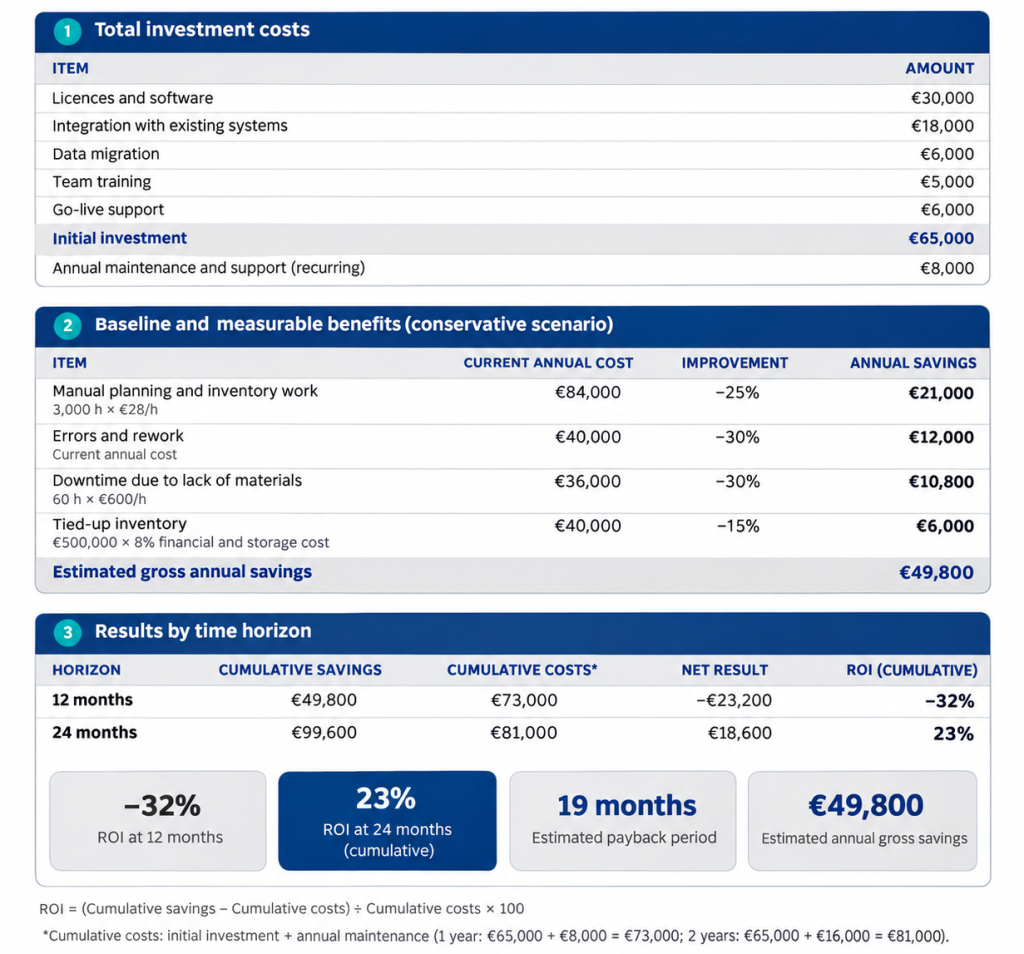
Let’s look at a hypothetical example: An industrial company invests €65,000 in a solution to improve its planning, inventory control, and process management. If it manages to generate estimated annual savings of €49,800, the investment will not yet have been recouped after 12 months. However, taking maintenance costs into account, the cumulative ROI would reach approximately 23% after 24 months.
How an ERP system like Sage X3 helps maximize the return on automation
Automating a process yields results; integrating it with the rest of the company multiplies those results. Sage X3 enables you to manage production, materials, inventory, quality, traceability, and the supply chain in an integrated manner, preventing information from being siloed in separate systems.