

Power BI drives analytics with compound semantic models: Direct Lake and Import Tables
In its ongoing commitment to transforming business analytics, Microsoft has taken a key step in the evolution of Power BI. The release of composite semantic models with integration between Direct Lake and Import Tables, announced on October 6, 2025, represents a technical and strategic revolution within the Microsoft Fabric ecosystem.
This innovation expands data analysis possibilities, optimizes performance and strengthens integration with artificial intelligence and Copilot, paving the way for a new generation of hybrid analytical models.
1. A new paradigm in data modeling
Compound semantic models allow combining different connection modes within the same model:
- Direct Lake tables, which directly access the data stored in OneLake.
- Imported tables, which are loaded into memory to speed up queries or apply advanced calculations.
This capability breaks through the limitations of previous approaches, such as DirectQuery + Import models, offering a more seamless, scalable and consistent experience.
The result is a hybrid model in which the analyst can choose, table by table, the most appropriate access mode according to business needs.
While large tables remain in Direct Lake to ensure performance and continuous updating, small dimensions or reference tables can be imported to enable complex calculations, hierarchies or calculated columns.
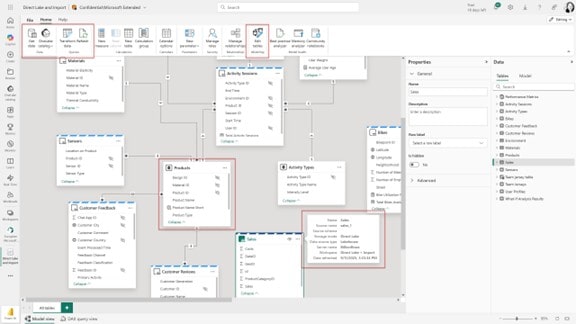
Figure 1 – screenshot of Power BI web modeling showing tables in Direct Lake storage mode and import storage mode within the same composite model, with options to add more tables.
2. Architecture and technical operation
In practice, a Direct Lake + Import composite model relies on the unified Microsoft Fabric infrastructure, which connects sources such as Lakehouses, Data Warehouses, SQL Databases or Dataflows within the OneLake environment .
The semantic model thus becomes a single business layer, where data stored directly in the lake coexist with other data loaded in memory or from external connectors.
Among its main advantages are the following:
- Latency reduction.
- Leveraging Fabric’s computing power.
- Creation, editing and publishing directly from Power BI Service.
This facilitates collaboration, governance and continuous deployment of enterprise analytics models.
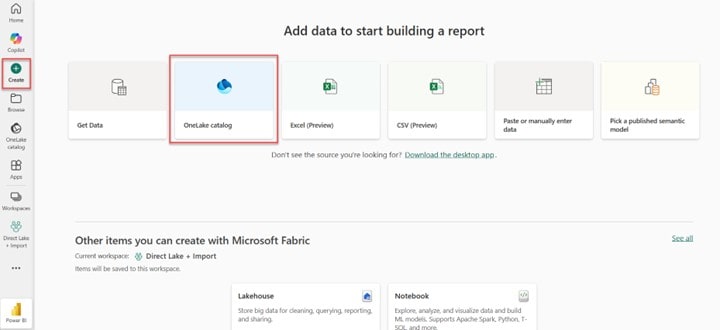
Figure 2 – screenshot of the creation page in the Power BI service showing the OneLake catalog tile used to create semantic models from scratch with Direct Lake tables.
3. Architecture and technical operation
- Increased flexibility by combining real-time data(Direct Lake) with preloaded data(Import).
- Improved performance over traditional DirectQuery models.
- Full compatibility with DAX relationships and measurements between both types of tables.
- Possibility of creating unified business models, avoiding duplication of datasets.
- Direct editing from the web, with parity with Power BI Desktop.
- Cost optimization thanks to direct reading from OneLake, reducing redundant storage.
4. Practical example: hybrid analysis of objectives and performance
Microsoft illustrates this innovation with a case study based on a delivery analysis scenario and business objectives.
- Delivery data (large volume) is maintained in Direct Lake mode.
- A CSV file with monthly targets is imported into the in-memory model.
Both sources are combined into a single semantic model that allows the calculation of key metrics, such as percentage of target achievement, monthly deviations and performance trends.
This hybrid approach demonstrates that it is possible to keep data up to date without sacrificing speed or computing power.
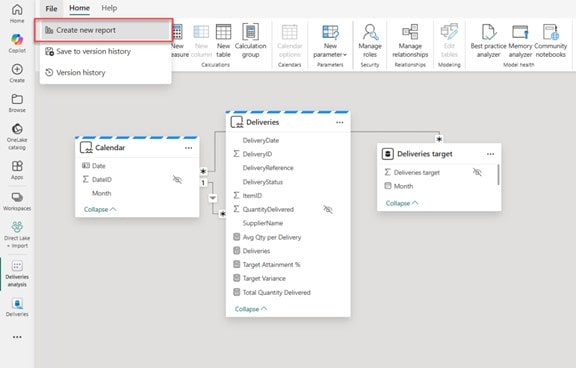
Figure 3 – Hybrid data model with Direct Lake and CSV file
5. Impact on analytics driven by AI and Copilot.
The move toward composite models not only improves performance, but also prepares Power BI for deeper use of AI.
With Copilot and the ability to prepare models directly from the service, analysts can:
- Interact with data using natural language.
- Perform AI-guided scans.
- Generate automated reports based on model semantics.
The mix of Direct Lake and Import makes it easier for models to be understood by Copilot, ensuring more accurate interpretation of data and enhancing conversational analytics.
6. Implications for organizations
This upgrade drives more agile, collaborative and secure analytics.
Finance, operations or marketing departments can integrate heterogeneous sources under a single data model, ensuring:
- Consistency in metrics.
- Data control.
- Compliance with corporate and regulatory standards.
In addition, editing from the web environment speeds up development and favors concurrent work.
7. PKF Attest’s vision
At PKF Attest we believe that this evolution consolidates the maturity of Power BI as an integral Business Intelligence platform.
The combination of Direct Lake and Import Tables allows you to build more robust, scalable and AI-ready analytics.
Our expertise in Microsoft Fabric allows us to accompany companies in the design of optimized hybrid models, driving digital transformation through data-driven decisions.
8. Conclusion
Composite semantic models represent a milestone in the evolution of Power BI.
Integration between Direct Lake and Import Tables provides a stronger foundation for advanced analytics, with native support for AI, increased performance and unified architecture.
This enhancement redefines how companies interact with their data, bringing the concept of “live analytics” closer : data that is updated, interpreted and transformed into strategic decisions in real time.
9. Sources
- Microsoft Power BI Blog (2025, October 6). Deep dive into composite semantic models with Direct Lake and import tables. https://powerbi.microsoft.com/en-us/blog/deep-dive-into-composite-semantic-models-with-direct-lake-and-import-tables/
- Microsoft Power BI Blog (2025, October 7). Prep your data for AI – now in the Power BI service. https://powerbi.microsoft.com/en-us/blog/prep-your-data-for-ai-now-in-the-power-bi-service
- Microsoft Learn. Power BI Documentation. https://learn.microsoft.com/en-us/power-bi/