

An AI-powered search engine for businesses enables users to find information quickly, accurately, and in context on corporate websites, intranets, and customer portals.
Unlike traditional keyword-based search engines, intelligent search interprets complete questions in natural language, understands the user's intent, and provides clear answers based solely on available content, thereby enhancing the digital experience and operational efficiency.
What is the purpose of an AI-powered search engine in business settings?
In organizations with large volumes of content, an AI-powered search engine helps reduce search times, improve understanding of the information, and cut down on repetitive inquiries to internal teams.
It is particularly useful on corporate websites, intranets, support portals, and technical documentation sites, where finding information the traditional way is slow and inefficient.
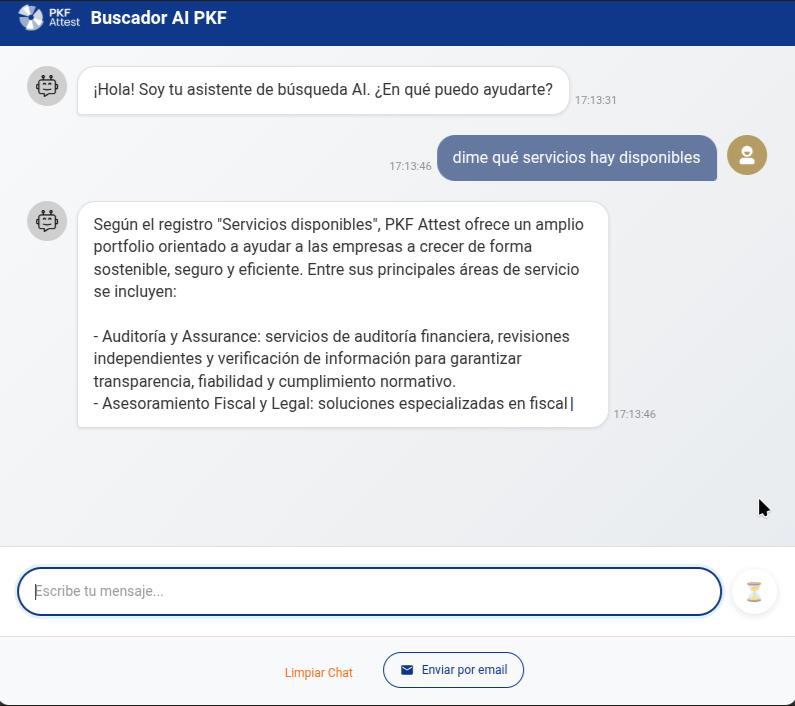
An AI-powered search engine for WordPress allows users to find information quickly, accurately, and in context within a website. Unlike traditional keyword-based search engines, an AI search engine interprets complete questions in natural language and generates clear answers based solely on the available content.
At PKF Attest, we have developed a smart website search engine that integrates as a WordPress plugin, designed to enhance the user experience, streamline digital processes, and reduce repetitive inquiries.
What is an artificial intelligence search engine?
An AI search engine is a tool that uses artificial intelligence models to analyze, interpret, and respond to queries made by users.
Instead of simply displaying a list of results, this system:
- Understand the context of the question.
- Identify relevant information.
- Generate a direct and structured response.
- You can respond in different languages.
This makes it a particularly useful solution for websites with large amounts of content, technical documentation, or complex information.
How does the AI search engine work in WordPress?
The search engine relies on two main elements: available information sources and user queries.
1. Preparation of information
The system can be powered by different sources, which are defined according to the needs of each project.
These include:
- Content published on the website itself (pages, posts, custom content types).
- Internal documents or information repositories.
- External sources, such as other websites or shared files.
All this information is organized and prepared so that the search engine can consult it efficiently and coherently.

2. Responding to user inquiries
When a user asks a question:
- AI analyzes intent.
- Look for relevant information.
- Generate a clear and contextualized response.
- It can automatically translate if the user queries in another language. The AI will give you the answer in the language you have chosen, correctly translating and contextualizing the available information.
This approach allows you to implement semantic search in WordPress, overcoming the limitations of traditional search engines.
How do we define search engine behavior?
One of the key features of this AI-powered search engine is the prompt configuration—that is, the set of instructions that defines how the AI should behave.
Unlike traditional chatbots, which require prior training based on questions and answers, our search engine relies on a customized prompt tailored to each organization and use case.
This prompt allows you to define, among other things:
- The tone of the responses (informative, educational, technical, friendly, corporate).
- The scope of the information (respond only with data available in the defined sources).
- The level of detail in the responses.
- Limitations and criteria for action (what can and cannot be responded to).
- How to redirect users to content, forms, or contact channels when necessary.
Thanks to this configuration, the search engine not only answers questions, but also communicates how the organization understands its context and provides answers consistent with its message, activity, and priorities.
Differences between an AI search engine and a traditional chatbot
Although the format may seem similar, this is not a conventional chatbot. Unlike traditional keyword-based search engines, this search engine uses artificial intelligence to interpret users' questions and provide understandable, contextualized answers.
- It does not engage in artificial conversations or follow predefined scripts.
- Do not "make up" answers or rely on general knowledge.
- Its main function is to search for, understand, and explain real information on the web.
It could be defined as an evolution of the classic search engine, capable of understanding complete questions and responding directly and contextually. The goal is not only to locate content, but also to provide useful answers, reducing the time and effort the user spends searching for information.
And if your users speak different languages, AI can adapt. This means that even if the original information is in Spanish, a user can make a query in English, French, or any other language, and receive a translated and coherent response.
| Traditional search engine | AI search engine |
|---|---|
| Search by keywords | Semantic interpretation |
| Results in list | Direct response |
| Not contextual | Contextualized |
| Not multilingual | Automatic translation |
| Find content | Explain content |
What can it offer organizations?
- Improved user experience. Visitors can access information more quickly and easily.
- Reduction in repetitive queries. Decreases the workload associated with answering frequently asked questions.
- Complete control over information. Responses are based solely on the sources that the organization decides to use.
- Potential to generate opportunities. The search engine can be integrated with contact flows or lead capture when the context requires it.
- Scalability and flexibility. Although based on a functional and simple model, the solution is designed to grow: incorporating new sources, expanding capabilities, and adapting to different uses and scenarios.

Smart search engine security
The AI search engine incorporates advanced protection to safeguard both organizational and user information.
Secure access
Each query is identified with a temporary access code that expires quickly, preventing unauthorized use. In addition, the number of searches is controlled to prevent abuse.
Smart validation
Each question is carefully reviewed before being processed, detecting and blocking any suspicious content that could compromise security.
Protected information
Data is managed using the same security standards as WordPress, ensuring that information remains intact and confidential.
Constant surveillance
All interactions are monitored to detect any unusual behavior and take immediate action if a problem arises.
Secure credentials
Access keys to external services are stored securely and verified continuously.
An evolving solution
An AI-powered search engine for businesses can be used on corporate websites, intranets, customer portals, or support centers, making it easier to access key information and reducing search times.
This solution is scalable and adapts to the actual needs of each organization.
This artificial intelligence search engine is part of our commitment to developing practical solutions with long-term viability. It is a scalable feature that can evolve progressively according to the actual needs of each project.
At PKF Attest, we continue to explore how to apply artificial intelligence in a useful and responsible way in digital environments. This search engine is an example of how we combine technology, judgment, and vision to improve the way people access information.